
AI Financial Advisor: What It Can (and Can’t) Do for Your Money in 2026
An AI financial advisor is an AI assistant — usually built on a large language model like ChatGPT, Claude, or Gemini — that helps you understand money, build a budget, and prep smarter questions for your investments and retirement. According to Investor.gov, only a person or firm registered with the SEC or a state securities regulator can legally provide personalized investment advice for compensation.
It’s a powerful learning and organizing tool, but it isn’t a licensed fiduciary — it can be confidently wrong, and it can’t legally give you personalized investment advice unless it’s run by an SEC-registered adviser. Here’s exactly where it helps, where it doesn’t, and how to use it safely.
Educational information only — not financial advice, and not a substitute for a licensed financial advisor. Consult a professional before making financial decisions.

What Is an AI Financial Advisor?
An AI-powered financial advisor is any AI assistant — general-purpose or purpose-built — that answers money questions, analyzes your spending, or helps plan for retirement using a large language model (LLM) and machine learning. Most people first meet the idea through ChatGPT, but the category also includes dedicated apps and the robo-advisors that have automated portfolio management for over a decade. Under the Investment Advisers Act of 1940, any product that gives compensated, personalized securities advice is expected to register as an investment adviser with the SEC or a state regulator — a rule that applies whether the “adviser” is a human or an algorithm.
Researchers at MIT Sloan have tested how close general-purpose LLMs already are to professional-grade advice. Economist Andrew Lo found that a plain, unmodified ChatGPT “doesn’t quite pass” a CFA-level finance exam — but comes close.
Without a module, ChatGPT “doesn’t quite pass, but it’s close. It’s actually remarkably close.”
Andrew Lo, MIT Sloan School of Management
AI advisor vs. robo-advisor vs. a licensed human advisor
These are three different things that get lumped under one label. A general-purpose AI assistant (ChatGPT, Gemini, Claude) can teach concepts and analyze the numbers you paste in, but it carries no fiduciary duty toward you — it isn’t legally bound to act in your best interest. A robo-advisor is narrower: it automatically allocates and rebalances a portfolio according to a fixed algorithm, usually inside a registered investment adviser’s platform. Regulated AI products such as Origin, Quinn, and PortfolioPilot sit in between — they can give personalized recommendations precisely because they operate under an SEC-registered investment adviser (RIA), not because the AI itself is licensed. In the United States, only a registered adviser — human or AI-assisted — can legally give you personalized investment advice for a fee.
How it actually works
A general LLM like ChatGPT answers from patterns learned during training, which is why it can explain concepts fluently but still get specifics wrong. MIT Sloan’s research shows that adding a finance-specific module — often built with retrieval-augmented generation (RAG), which feeds the model verified, current financial data instead of relying purely on its training — measurably closes that gap and pushes performance toward a passing, professional-grade level. That distinction matters: a bare LLM chatbot and a purpose-built financial AI product are not interchangeable, even when both call themselves an AI financial planner.
What an AI Financial Advisor Can and Can’t Do
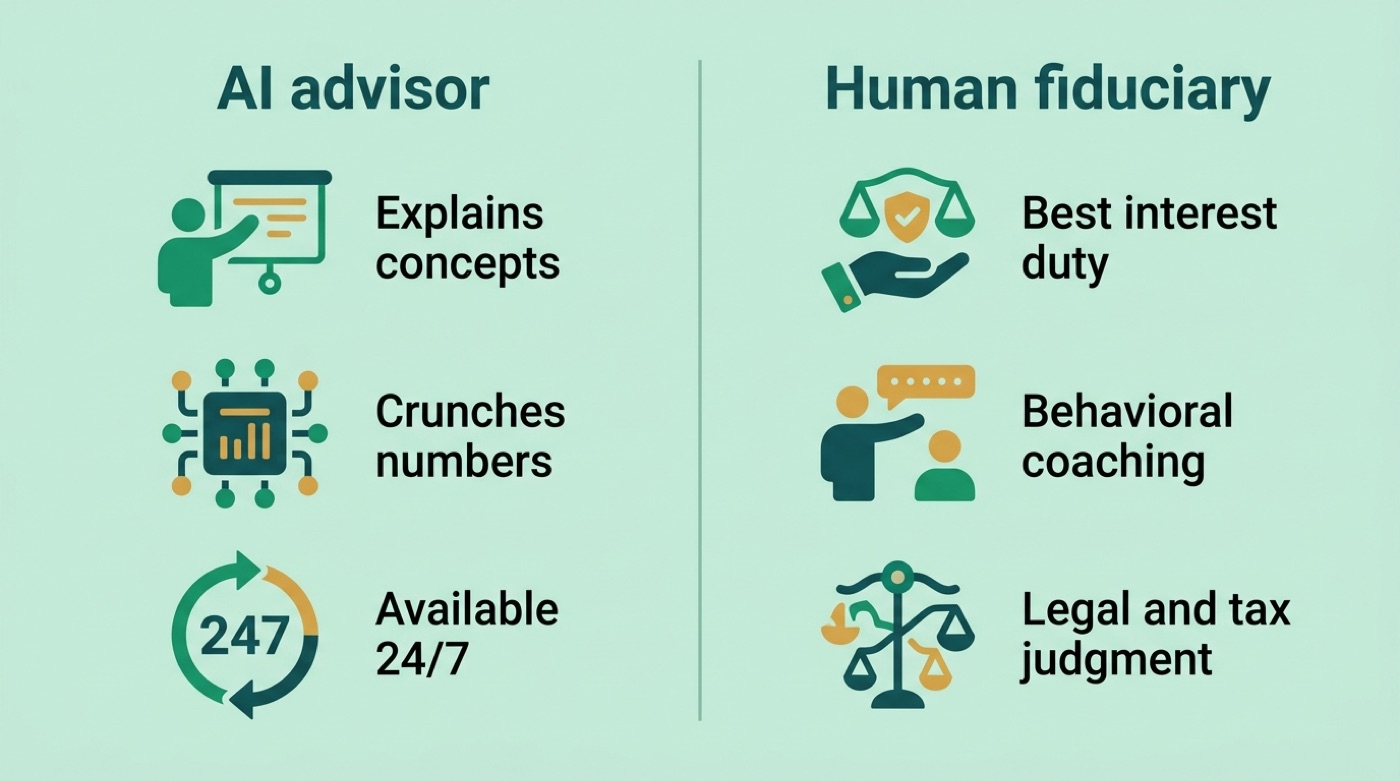
The honest way to frame this: AI is strong at analytics, weak at judgment calls that involve your specific life and emotions. The table below splits the two.
| Task type | AI financial advisor | Human fiduciary advisor |
|---|---|---|
| Explaining concepts (ETFs, 401(k), Roth vs. Traditional) | Strong — fast, plain-English, available 24/7 | Strong, but slower and often billed by the hour |
| Crunching numbers (cash flow, rebalancing math, Monte Carlo runs) | Strong — high-volume, repeatable analysis | Strong, typically supported by the same software |
| Personalized, compensated investment advice | Only if backed by an SEC-registered RIA | Yes, when the advisor is a fiduciary |
| Behavioral coaching during market volatility | Weak — no accountability, can be confidently wrong | Strong — this is where advisors earn their fee |
| Legal/tax/estate decisions | Not qualified | Strong, or refers to a specialist |
Where AI genuinely helps. Analytics-driven tasks — gathering data, building a risk profile, mapping cash flow, running rebalancing math, or projecting outcomes with Monte Carlo simulations — are exactly where large language models and machine learning add real speed. AI also does well at teaching the basics: how a 401(k) match works, what a budgeting method actually means, summarizing a dense plan document, or drafting the questions you should bring to your next advisor meeting.
Where AI falls short (and can hurt you) breaks down into a few concrete risks:
- Hallucination. An AI financial advisor can sound completely confident while stating a wrong number, an outdated tax rule, or a made-up rate — always verify figures against a primary source before acting.
- No fiduciary duty. A general-purpose assistant is not legally obligated to act in your best interest the way a fiduciary advisor is.
- Algorithmic bias. MIT Sloan’s testing found that large language models can reproduce historical biases in their training data, including gender bias, in ways that can subtly skew financial guidance.
- Empathy gap. AI consistently underperforms on empathy-driven work — behavioral coaching, talking someone out of panic-selling in a downturn, or navigating a life transition like divorce or a job loss.
Because of these limits, no single AI tool should be your only source of financial guidance for decisions with real stakes.
Popular AI Tools for Personal Finance
The tools people actually use split into two groups: general-purpose assistants you already have, and dedicated products built specifically for financial planning.
ChatGPT tends to be the strongest pick for learning concepts in plain English — asset allocation, tax brackets, what an expense ratio means. Google Gemini fits naturally if your financial life already lives in Google Workspace, since it can work directly with Gmail, Drive, and Sheets. Microsoft Copilot does the same job for people anchored in Microsoft 365 — Outlook, Word, and Excel. Claude stands out for reading and summarizing long PDFs — retirement plan documents, brokerage statements, and disclosure packets that would take an hour to read manually. None of the four carries a fiduciary duty or SEC registration on its own.
| Tool | Best for | Key limit |
|---|---|---|
| ChatGPT | Learning concepts, plain-English explanations | No fiduciary duty; general-purpose training data |
| Google Gemini | Users living in Gmail, Drive, and Sheets | Same fiduciary and accuracy limits as any LLM |
| Microsoft Copilot | Users living in Outlook, Word, and Excel | Same fiduciary and accuracy limits as any LLM |
| Claude | Reading and summarizing long financial PDFs | Doesn’t manage money or place trades |
| Origin, PortfolioPilot, Quinn | Personalized advice backed by an SEC-registered RIA | Registration doesn’t guarantee skill or outcome |
Dedicated AI financial advisor products
A separate category of tools is built specifically around personal finance and operates through a registered adviser structure:
- Origin describes itself as a full-spectrum AI financial advisor operating through an SEC-registered investment advisory entity, offering non-discretionary guidance across budgeting, investing, and retirement.
- PortfolioPilot, built by Global Predictions Inc. (also an SEC-registered RIA), offers read-only portfolio analysis on a free tier and paid Gold, Platinum, and Pro plans, without taking custody of your money.
- Quinn is an SEC-registered investment advisor platform that financial institutions embed into their own apps.
- Free Financial Plan and similar Financial Planning GPT-style tools run on top of ChatGPT and are free to try without an account.
In every case, SEC registration is a regulatory requirement to operate — it does not, by itself, guarantee skill, accuracy, or an endorsement from the SEC.
Using AI for Budgeting and Saving
Budgeting is one of the lowest-risk, highest-value uses of an AI-powered financial assistant, and the Consumer Financial Protection Bureau publishes free tools covering the same fundamentals if you want a source that isn’t AI-generated.
Building a budget with AI
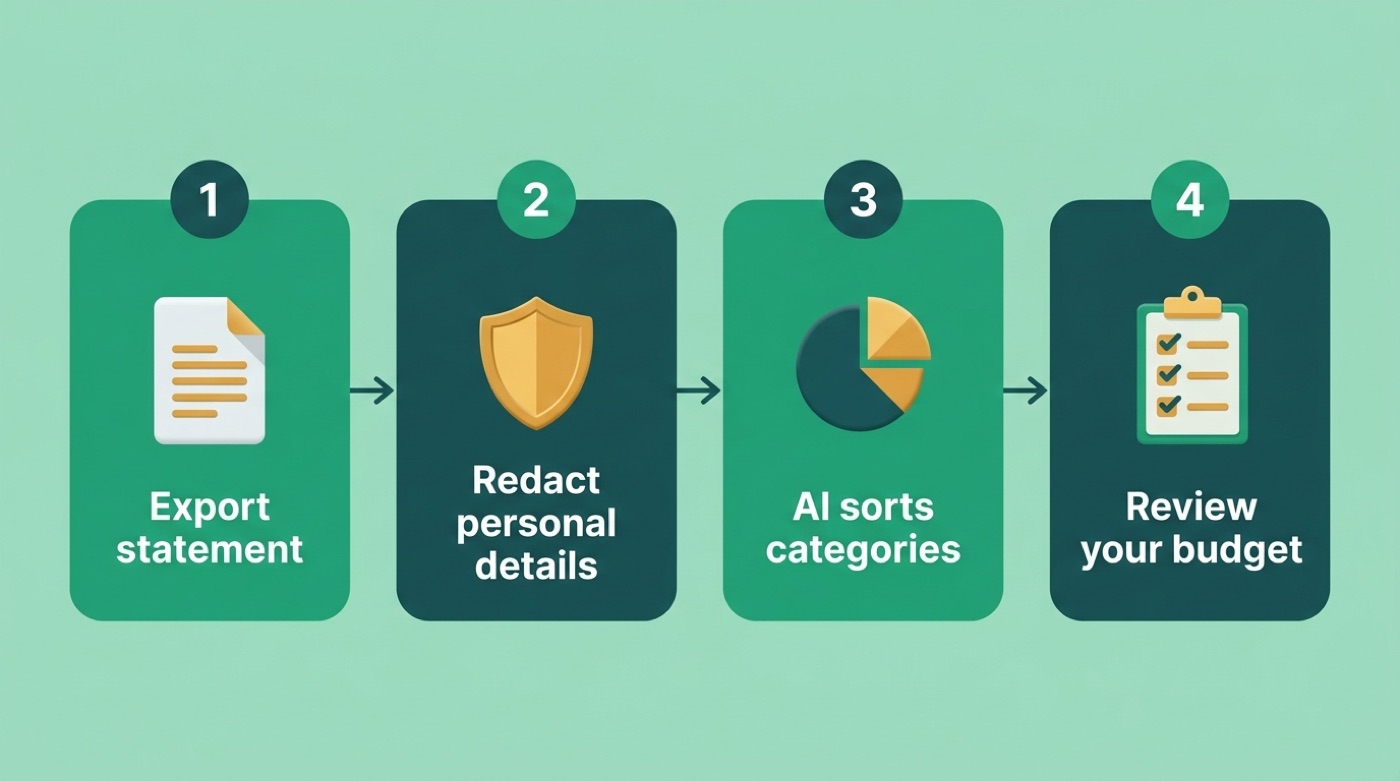
A common workflow: export a bank statement as a CSV, strip out account numbers and other identifying details, and ask the AI to group transactions into categories, flag recurring subscriptions, and lay out a simple monthly budget. A typical prompt looks like: “Group these transactions into categories, flag anything recurring, and total spending by category for the month.” The output is a starting draft, not a final plan — verify category totals against your actual statement before relying on it.
Finding savings and tracking net worth
Beyond categorizing, an AI financial planner can scan for patterns you’d miss manually — duplicate subscriptions, a creeping category, or a direct answer to “where can I realistically save an extra $500 a month?” Net worth tracking takes this a step further, pulling bank balances, 401(k) and IRA statements, and other assets into a single running view so you can see your full financial picture in one place instead of five different logins.
Using AI for Basic Investing
Investing is where the line between “explain a concept” and “give me personalized advice” matters most, and where regulation is strictest.
Learning the fundamentals: index funds and diversification
AI is genuinely good at explaining the mechanics — what an index fund or ETF is, why diversification reduces risk, how asset allocation works across stocks, bonds, and cash. What it can’t legally or reliably do is tell you whether your specific portfolio is overexposed to a single sector like tech; that crosses from education into personalized advice. For authoritative definitions of these terms, Investor.gov is a free, non-commercial reference.
Portfolio analysis (and its limits)
Asset allocation math, tax-loss harvesting logic, and rebalancing triggers are exactly the kind of repeatable, rules-based tasks where AI and algorithms already outperform manual tracking on consistency — though exceptions and edge cases still benefit from human oversight. Some dedicated platforms cite third-party estimates for the value of continuous, automated tax optimization, but any such figure is a modeled estimate from a specific provider, not a guaranteed return. All investing carries risk, including the risk of losing the money you invest, regardless of whether a human or an AI is doing the analysis.

Using AI for Retirement Planning (401(k), IRA)
Retirement questions are some of the most common things people bring to an AI money advisor, largely because plan documents are dense and jargon-heavy.
Understanding your 401(k) and IRA
A useful pattern here is uploading your plan summary and asking the AI to explain, in plain terms, your employer match, vesting schedule, and available investment options. A specific prompt works better than a vague one — for example: “Explain Roth vs. Traditional contributions in plain English for a W-2 employee in a 24% tax bracket.” Don’t let the AI make the final selection of which funds to hold; use it to understand the options, then decide — or bring the summary to a professional. For exact contribution limits and plan rules, IRS.gov is the authoritative source.
Retirement projections and their caveats
Monte Carlo simulations model a range of possible retirement outcomes by running thousands of variations of market returns, inflation, and withdrawal rates. AI tools can generate and update these projections quickly as your numbers change, which is where they add real value — but treat any specific “success rate” percentage as an illustration of the method, not a promise about your actual future. A human advisor is well positioned to sanity-check the assumptions behind the simulation.
Using AI to Tackle Debt
Debt payoff is a numbers-heavy problem that AI handles well, provided you feed it accurate figures.
Here’s a simple step-by-step way to build an AI-assisted payoff plan:
- List every debt with its balance, interest rate, minimum payment, and remaining term.
- Decide how much extra you can realistically put toward debt each month.
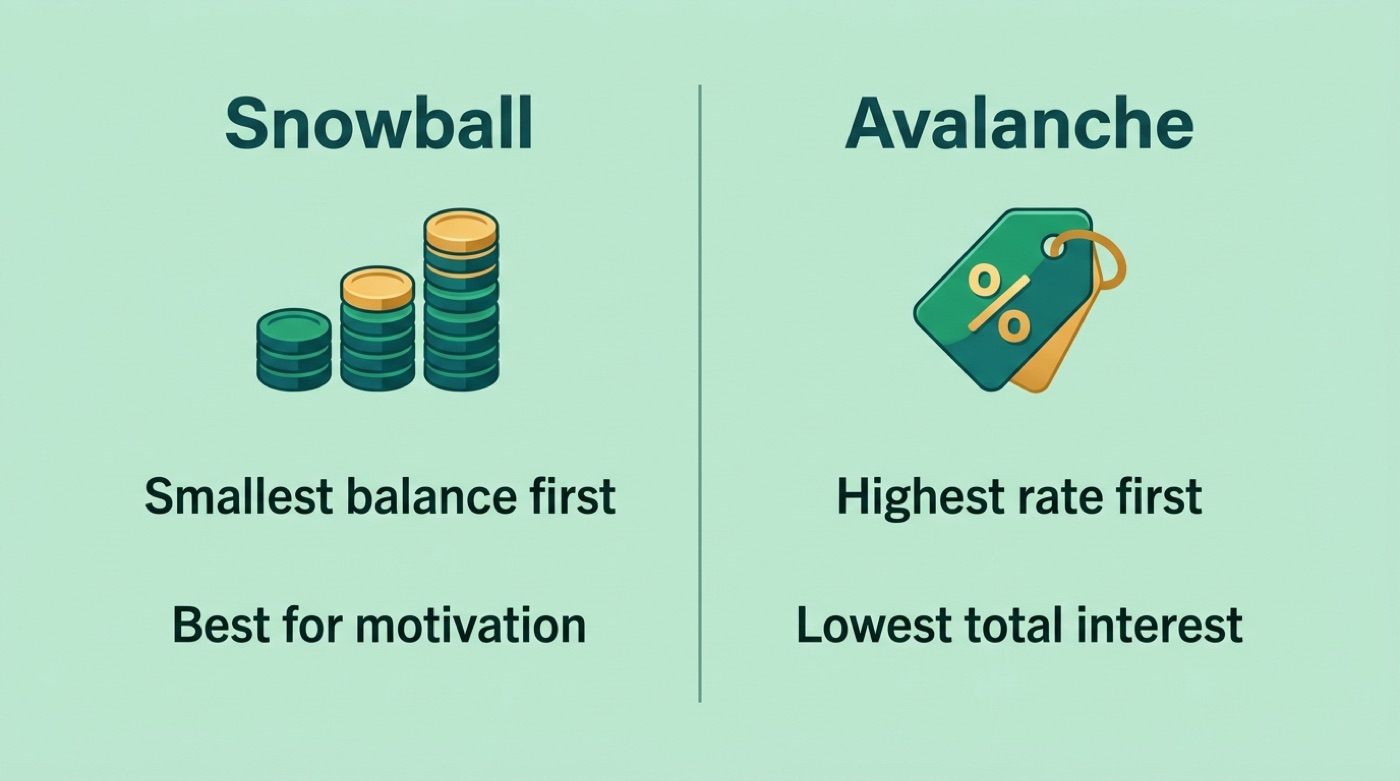
- Ask the AI to model a debt snowball payoff (smallest balance first) using those numbers.
- Ask it to also model a debt avalanche payoff (highest interest rate first).
- Compare the total interest paid and payoff timeline for each method.
- Pick the version you’ll actually stick with — snowball for motivation, avalanche for lower total cost.
- Re-run the numbers every few months as balances change.
For neutral, non-AI guidance on the same methods, the CFPB’s debt management resources are a solid cross-check.
How to Use an AI Financial Advisor Safely
Privacy and accuracy are the two risks that matter most when you bring an AI into your finances.
What never to share with AI
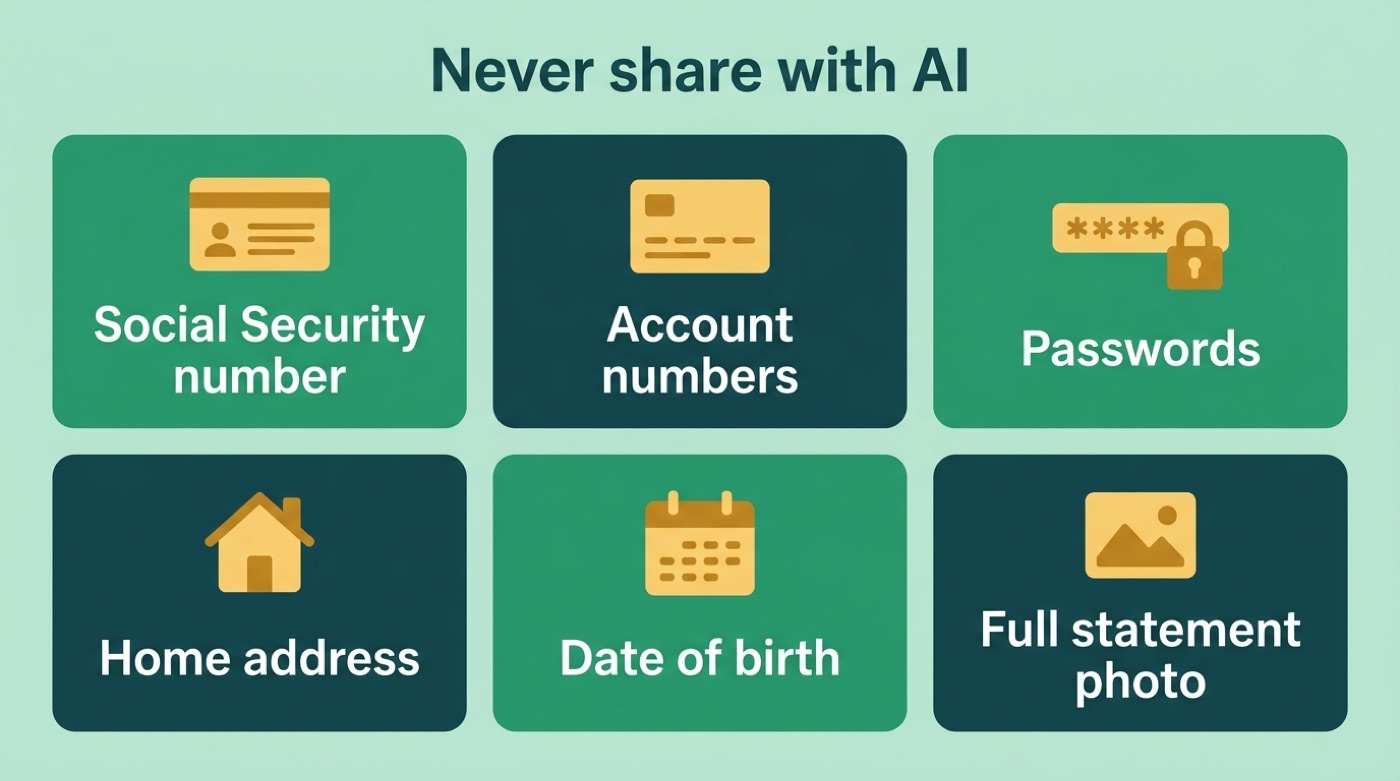
Never share these with an AI financial advisor:
- Social Security number
- Driver’s license or other government ID number
- Home address and date of birth
- Full, un-masked account numbers
- Passwords or login credentials
- An unredacted full statement or a photo of a financial document
Category totals, anonymized transaction lists, and excerpts from a plan document with names removed are generally fine after you’ve stripped identifying details.
Verify everything and manage privacy
AI can be confidently wrong, so cross-check numbers and rules against a primary source before acting on them — the SEC, IRS, or CFPB pages linked throughout this guide are good starting points. Most major assistants let you turn off training on your conversations: in ChatGPT, that’s under Settings → Data Controls; in Claude, under Settings → Privacy. FINRA publishes investor guidance specifically on AI tools in investing, including what to check before trusting an AI-generated recommendation.
When to See a Human (Fiduciary) Advisor
Educational information only — not financial advice, and not a substitute for a licensed financial advisor. Consult a professional before making financial decisions.
What a fiduciary does that AI can’t
A fiduciary advisor is legally obligated to put your interests first — a standard no general-purpose AI tool is bound by. That duty matters most in exactly the situations AI struggles with: behavioral coaching during a market drop, goal-setting around a career change, or walking through a major life transition. Bring in a licensed professional for tax strategy, large one-time investment decisions, retirement account withdrawals, and estate planning — areas where mistakes are expensive and hard to reverse.
The hybrid approach: AI prep + human decision
The pattern that shows up across the research and the products themselves is a hybrid one: use AI to prepare — organizing documents, drafting questions, summarizing what happened after a meeting — and make the actual decisions with a fiduciary advisor. Even inside advisory firms, AI increasingly functions as a co-pilot that speeds up analysis, while a human professional retains final responsibility for the recommendation and the relationship.
Guides: explore the topic in depth
These deeper guides expand on everything above — how an AI financial advisor compares to the alternatives, whether it is regulated and safe, and how to use one for each money job:
- AI financial advisor vs. a human advisor
- AI financial advisor vs. a robo-advisor
- Are AI financial advisors regulated?
- Can you trust an AI financial advisor?
- Is an AI financial advisor safe with your data?
- Using an AI financial advisor for budgeting
- Using an AI financial advisor for investing basics
- Using an AI financial advisor for retirement planning
- Using an AI financial advisor to pay off debt
- Using ChatGPT as an AI financial advisor
- The best AI financial advisor tools
Frequently asked questions
- Can I use AI as a financial advisor?
Yes, for learning, analysis, and organizing your money — but not as a full replacement. A general-purpose AI tool has no fiduciary duty toward you, and only an SEC-registered adviser can legally give personalized investment advice. Use AI alongside a licensed professional, not instead of one.
- Is there a free AI financial advisor?
Yes. ChatGPT, Gemini, Claude, and Copilot all have free tiers, and some dedicated tools have a free basic plan. Free access doesn’t mean personalized, licensed advice — check what each tool is actually authorized to do.
- Can ChatGPT give financial advice?
ChatGPT explains financial concepts and analyzes numbers you paste in, but it can be confidently wrong and carries no fiduciary duty. Verify anything specific against a primary source such as the SEC, IRS, or CFPB before acting on it.
- Is it safe to give AI my financial information?
Only after redacting sensitive details. Never share your Social Security number, account numbers, passwords, or an unredacted statement. Turn off chat training in your settings and stick to category totals or anonymized data where possible.
- Will AI replace financial advisors?
Unlikely in full. AI is strong at analytics-driven tasks like rebalancing math and projections, but it underperforms on empathy-driven work such as behavioral coaching and life planning — which is where human advisors add the most value. Most research points to a hybrid future, not a replacement.
- Are AI financial advisors regulated by the SEC?
General-purpose chat assistants are not. But products that give personalized investment advice, such as Origin, PortfolioPilot, and Quinn, operate through an SEC-registered investment adviser. Registration is a legal requirement to give that advice — it does not imply a guaranteed level of skill or an SEC endorsement.